







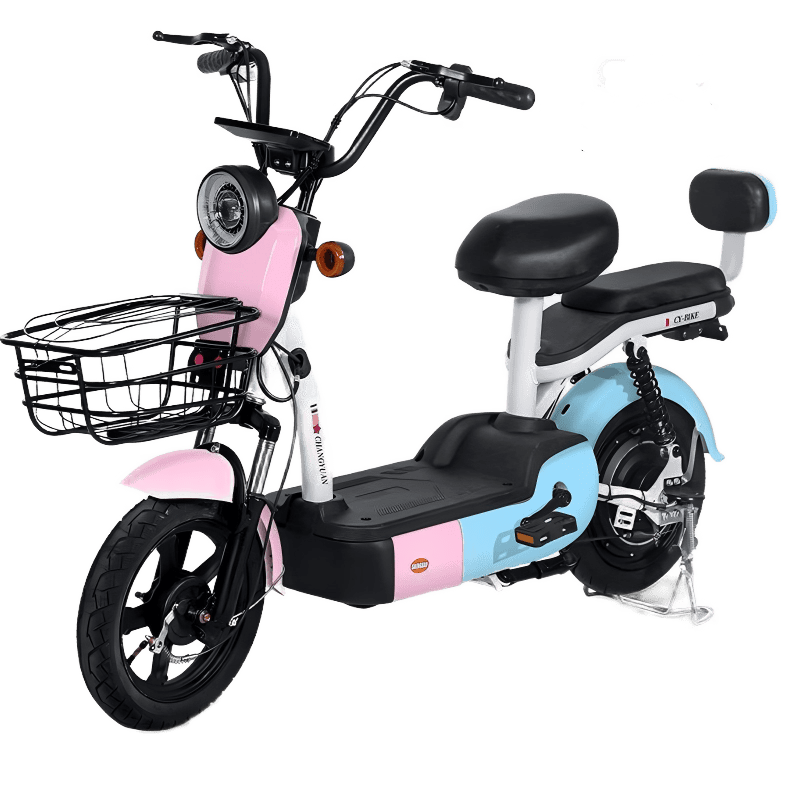
Electric Bicycle-Sweetened Red Beans
Complete Product Specifications
Performance & Power
| Parameter | Value |
|---|---|
| Motor Power | 350W / 500W |
| Operating Voltage | 48V System |
| Battery Type | Lead-Acid Battery / Lithium Battery |
| Maximum Load Capacity | 150+ kg |
| Motor Lock | Rear Wheel Motor Lock |
Build & Components
| Component | Specification |
|---|---|
| Shell Material | High-Durability Plastic |
| Tire Type | Vacuum Tire (Puncture-Resistant) |
| Brake System | Front + Rear Drum Brakes |
| Suspension | Front + Rear Dual Shock Absorbers |
| Rearview Mirror | Yes (Left and Right) |
Lighting & Safety
| Feature | Specification |
|---|---|
| Headlight | LED Headlights |
| Turn Signals | Front + Rear Dual Turn Signals |
| Instrument Display | Digital Display (Speed, Battery, Mileage) |
| Remote Control | Yes (Keyless Entry) |
| Certification | CE, DOT Available |
Build Your Brand Identity
Tailor the Sweetened Red Beans to your market needs while keeping it cost-effective. All options preserve the competitive pricing that makes this model ideal for budget-conscious segments and high-volume operations.
✓Battery & Motor — Lead-acid for affordability / lithium for range; 350W flat / 500W hills.
✓Color & Branding — Standard colors or custom (200+ units); single side-panel logo (50+ units).
✓Accessories & Voltage — Front basket, rear rack, phone holder; 110V/220V charging config.
✓Language Customization — Manual and display language per target market.
MOQ — 50 units standard / 100 units color custom
Lead Time — 30-35 days
FREQUENTLY ASKED QUESTIONS
Why are drum brakes used instead of disc brakes?
Drum brakes are a deliberate cost choice for this budget model, costing about 30-40% less than disc systems and lowering the unit price that entry-level and fleet buyers depend on. The enclosed mechanism needs far less maintenance against water, mud, and debris common on unpaved roads in developing markets. They give adequate stopping power for the moderate speeds of urban commuting and delivery, trading a little responsiveness for lower lifetime cost.
What makes this model suitable for emerging markets?
It is engineered for markets where price and durability matter more than premium features: lead-acid gives the lowest entry price, durable plastic bodywork resists chips and rust, and vacuum tires avoid punctures on poor roads. The 150kg+ capacity handles heavier riders and cargo typical of family or commercial use, while simple mechanics reduce reliance on specialized repair shops. Distributors across Southeast Asia, Africa, and Latin America specifically request it for these traits.
How does the pricing compare to the Princess Lanqi model?
The Sweetened Red Beans costs 25-35% less, achieved through drum brakes, simpler shell molding, standard colors, and streamlined assembly—without dropping core function. Both share the same 48V motor platform, dual suspension, LED lighting, turn signals, remote control, and digital display. Distributors can thus cover budget and style buyers from one supplier instead of sourcing from multiple factories.
Can this model handle daily commercial delivery use?
Yes—it suits urban delivery where low acquisition cost and fleet scalability come first, with 150kg+ capacity for a rider plus 30-40kg of cargo. Vacuum tires cut puncture downtime on multi-stop routes, and the lead-acid option keeps replacement batteries cheap under daily use. We recommend the 500W motor and, for daily radius over 25km, lithium; many Asian delivery platforms already run large fleets of this model.
What is the expected lifespan and total cost of ownership?
With proper care, the frame and electrical system last 4-6 years or 40,000-60,000km; lead-acid batteries need replacing every 1-2 years (300-500 cycles) and lithium every 3-5 years (800-1,200), with drum brakes adjusted every 6 months and tires lasting 2-3 years. Over 5 years a lead-acid unit in daily use totals about 150-180% of its purchase price in TCO. That is 30-40% below premium models thanks to cheaper battery and brake replacements, making it the most economical choice for large fleets.
Are there any features this model does NOT include?
To hold the price, it drops hydraulic suspension (mechanical springs only), metallic/chrome finishes, an integrated USB port, premium leather seating, and a color/Bluetooth display. All safety-critical items remain: LED lights, turn signals, dual brakes, rearview mirrors, and remote lock for compliance and rider safety. The trade-off removes non-essential luxury rather than functional capability.
What customization requires the lowest MOQ for market entry?
The 50-unit MOQ includes your choice of 350W or 500W, lead-acid or lithium, one of five standard colors, and basic single-color logo printing at no extra cost. That lets you enter with a branded budget e-bike without hitting the 100-unit custom-color or 200-unit premium-accessory thresholds. Many new distributors split 50 units between lead-acid and lithium to test demand, then scale up after validating the market.
How is this model packaged and what is the container loading quantity?
Each unit ships 80% pre-assembled in a compact carton (~140×45×70cm), needing 10-15 minutes to fit the front wheel, handlebar, and mirrors. Container loading reaches about 150-180 units per 20GP or 380-420 per 40HQ, slightly better than premium models due to simpler packaging. We use sea-worthy cartons with wooden crate reinforcement to protect cost-sensitive shipments over long ocean routes.
What warranty and after-sales support is included?
Standard coverage is 1 year on frame, motor, and electrical, with the battery at 1 year/300 cycles (lead-acid) or 2 years/800 cycles (lithium)—industry-standard for the budget segment. We provide a 24/7 English hotline, video assembly guides, and illustrated repair manuals, with spare parts shipping in 48-72 hours from regional warehouses. Fleets of 200+ get extended warranty, on-site training, and priority parts access.
Why is this model named "Sweetened Red Beans" and how should it be marketed?
The name reflects an Asian cultural value of affordable, wholesome sustenance—positioning the bike as essential transport, not a luxury lifestyle product. Marketing should stress practical benefits (reliable daily use, low purchase and operating cost, durability, proven commercial record) over aspiration, targeting delivery platforms, first-time EV buyers, budget-rental operators, and price-sensitive commuters. Avoid competing on style; lead with total cost of ownership, parts availability, and installed base, and consider a localized name for Western markets where the reference may not land.