







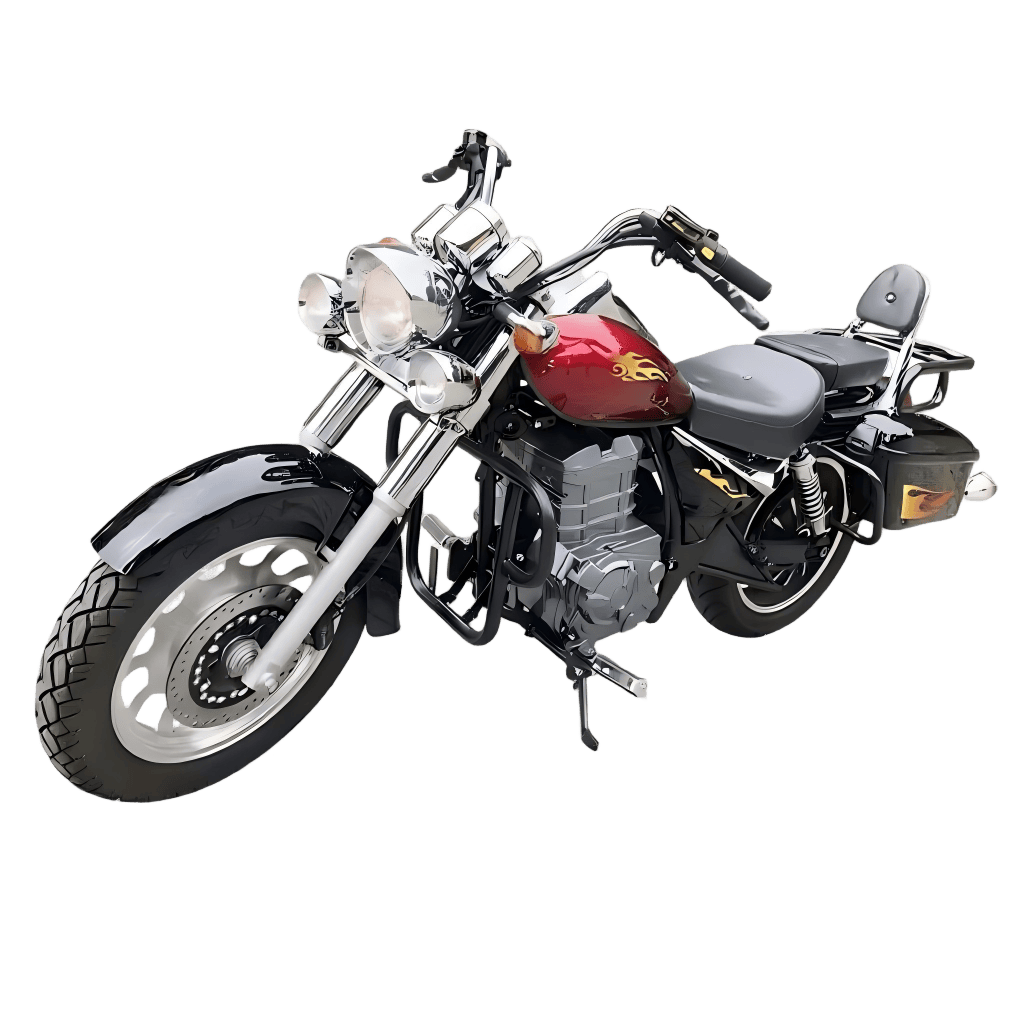
Crown Prince
Complete Product Specifications
Complete Product Specifications
| Parameter | Value |
|---|---|
| Motor Specifications | 16-inch 3000W Motor |
| Maximum Speed | ≤120 km/h |
| Climbing Capacity | ≤20° Incline |
| Gear Shifts | 3-Speed Transmission |
| Reverse Function | Yes |
| Hazard Lights | Yes |
Chassis & Dimensions
| Component | Specification |
|---|---|
| Body Dimensions (L×W×H) | 2330 × 850 × 1120 mm |
| Wheelbase | 1480 mm |
| Ground Clearance | 170 mm |
| Front Suspension | Hydraulic Shock Absorber |
| Rear Suspension | Hydraulic Shock Absorber |
| Package Dimensions | 2000 × 580 × 1150 mm |
Braking & Features
| System | Specification |
|---|---|
| Front Tire | 100/90-16 (Motorcycle-Grade) |
| Rear Tire | 140/70-16 (Motorcycle-Grade) |
| Front Brake | Hand-Operated Disc Brake |
| Rear Brake | Hand-Operated Disc Brake |
| Instrument Display | Speed / Battery / Turn Signal / Headlight |
| Available Colors | Black / White / Blue / Red |
Build Your Brand Identity
Tailor the Crown Prince to create a distinctive premium product that commands attention and justifies luxury positioning. All options keep the sophisticated performance and quality of this flagship.
✓Color & Performance Tuning — Standard/custom metallic finishes, chrome accents; controller programming for limits, accel, regen.
✓Luxury Finishing & Comfort — Premium seat, chrome trim, LED accents, TFT display; windscreen, heated grips, suspension tuning, sound system, USB.
✓Advanced Safety — ABS, traction control, LED lighting, dash camera, GPS.
✓Branding & Battery — Backlit logo, branded startup, side graphics, fleet ID; extended-range lithium, quick-swap, BMS, cold-weather.
MOQ — 20 units standard / 50 units full luxury custom
Lead Time — 45-50 days
FREQUENTLY ASKED QUESTIONS
Common Questions About Crown Prince
Our premium consumer electric motorcycle with a 3000W motor delivering genuine 120km/h motorcycle performance, not scooter-level power. The 16-inch motorcycle tires give high-speed stability that 12-13 inch scooter wheels can’t, the 1480mm wheelbase adds road presence, and dual hydraulic suspension rides smoother than mechanical springs. It targets buyers paying 50-70% over mid-range models for real performance, refinement, and distinctive styling, competing with premium gas motorcycles and high-end e-scooters—not budget e-bikes.
How does 120km/h capability translate to real-world performance?
Versus 25-45km/h e-bikes, it makes highway travel practical and urban merging confident. Real use is 50-80km/h urban or 80-100km/h highway, with max reserved for brief acceleration or emergencies. Battery drains 3-4x faster at 120 than at 40km/h, so most riders value the capability without sustaining it—like horsepower in a car.
What regulatory challenges exist for 120km/h electric motorcycles?
Vehicles over 45-50km/h usually classify as motorcycles—registration, insurance, license, helmet—losing e-bike simplicity. The EU requires L3e type approval; US varies by state (mostly motorcycle above 30-35mph); Asia needs full motorcycle licenses. We provide market guidance and adjustable speed limiting to meet class thresholds while keeping underlying performance.
What is the realistic range for highway versus urban use?
A 72V 50Ah lithium gives ~100-120km urban at 40-50km/h, 60-80km highway at 80-90km/h, 40-50km at 100-120km/h, and 70-90km mixed. The 3-speed transmission optimizes gearing; cold below 10°C cuts 25-30%, aggressive riding 30-40%. Plan at 70% of max; extended-range packs add 40-60%.
How does the Crown Prince compare to traditional gasoline motorcycles?
Advantages: zero emissions, 80-90% lower running cost, stronger 0-50km/h torque, minimal maintenance, quiet operation. Disadvantages: 30-50% higher price, 60-120km range vs 200-300km for gas, 4-8h charging vs 2min, fewer chargers, battery replacement after 3-5 years. Best for urban riders doing 40-80km daily with home charging; less practical for rural or long-distance touring.
What maintenance schedule applies to high-performance electric motorcycles?
Tires inspected every 500km, replaced 6,000-10,000km; brakes inspected 1,000km, discs 10,000-15,000km; hydraulic suspension serviced every 6 months, rebuilt 12-18 months; BMS checked quarterly, battery replaced 3-5yr/600-1000 cycles; chain cleaned 500km, replaced 5,000-8,000km; electrical inspected quarterly; motor bearings annually; controllers 5-7yr. Annual upkeep runs ~8-12% of purchase price excluding battery.
Can the Crown Prince use standard motorcycle tires and parts?
Yes—a key advantage. The 16-inch wheels take standard sizes (100/90-16 front, 140/70-16 rear) from Michelin, Pirelli, Dunlop and others; disc brakes, chain, and sprockets are also standard motorcycle parts, simplifying sourcing and cutting China-supply dependency. The motor, controller, BMS, and instrument cluster remain proprietary. This hybrid keeps local availability for wear items while preserving specialized powertrain performance.
What training is required for dealers to sell and service the Crown Prince?
Sales training 2-3 days (specs, positioning, legal, financing, test rides); technical service 3-5 days (high-voltage safety, diagnostics, battery, suspension, brakes); software/diagnostic 1-2 days. Orders of 50+ get on-site training; dealers need high-voltage workshop safety. We supply manuals, diagnostic software, and a hotline; some markets require HV certification, which we document.
What insurance and licensing requirements typically apply?
It needs motorcycle classification: full motorcycle license (not simplified e-bike permits), mandatory helmet, and often annual/biennial inspection. Insurance starts at motorcycle liability minimums, with comprehensive 10-20% above 250cc gas bikes due to higher replacement cost and limited repair network—partly offset by EV discounts. Registration fees match 250-400cc gas. Fleet commercial insurance is harder to source; we connect buyers with specialized insurers.
How should the Crown Prince be marketed to justify premium pricing?
Position it above utility into lifestyle and aspiration—lead with genuine 120km/h capability and compare against premium gas motorcycles, not budget e-bikes. Feature successful, discerning riders and emphasize exclusivity over mass appeal. Highlight 3-5-year total cost of ownership (fuel savings, low maintenance, retained value) and use environmental benefit as support, not the main pitch. Offer a premium purchase experience (test rides, financing, concierge service) and hold the price—competing on cost undermines the quality perception.