







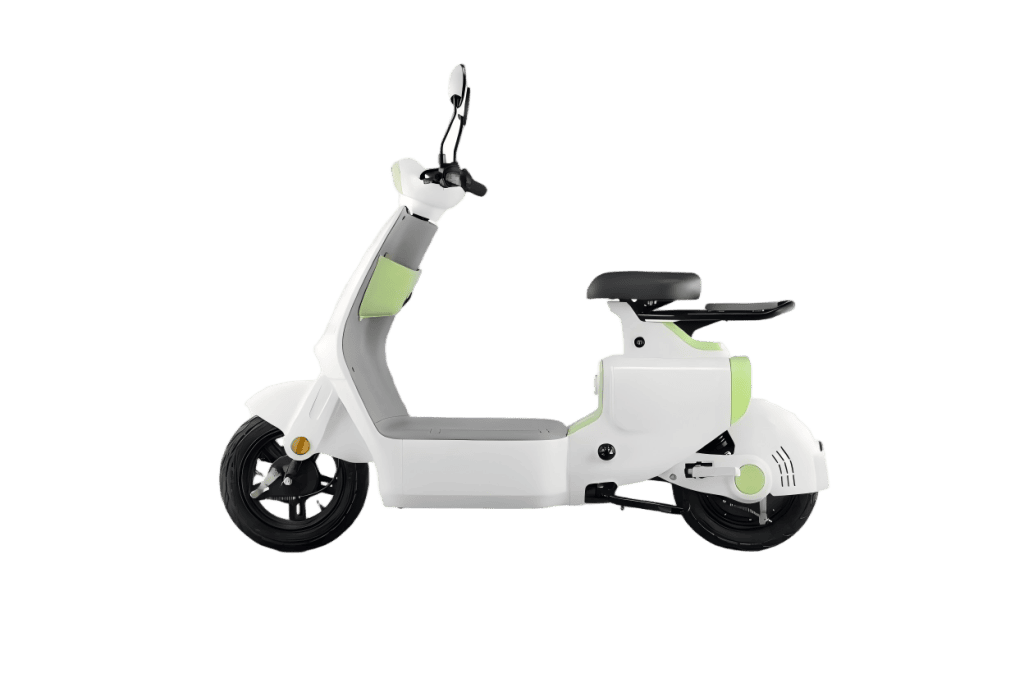
Bicicleta eléctrica - H1
Especificaciones completas del producto
Rendimiento y potencia
| Parámetro | Valor |
|---|---|
| Potencia del motor | 500W / 800W / 1000W Options |
| Tensión de funcionamiento | 48V / 60V System |
| Tipo de batería | Batería de plomo-ácido / Batería de litio |
| Capacidad máxima de carga | Más de 200 kg |
| Cierre motorizado | Bloqueo del motor de la rueda trasera |
Construcción y componentes
| Componente | Especificaciones |
|---|---|
| Construcción del bastidor | Reinforced High-Performance Frame |
| Material de la carcasa | Plástico de alto impacto |
| Tipo de neumático | Neumático de alto rendimiento para servicio pesado |
| Sistema de frenos | Front + Rear Drum Brakes (Performance-Rated) |
| Espejo retrovisor | Sí (izquierda y derecha) |
Funcionalidades inteligentes y seguridad
| Característica | Especificaciones |
|---|---|
| Faro | High-Brightness LED Headlights |
| Intermitentes | Intermitentes dobles delanteros y traseros |
| Pantalla del instrumento | Digital Display (Speed, Power, Battery) |
| Mando a distancia | Sí (acceso sin llave) |
| Certificación | CE, DOT Available (Region-Specific) |
Crea tu identidad de marca
Tailor the H1 high-performance model to your market’s power requirements and regulatory environment. All options keep the capability that defines this flagship.
✓Motor & Voltage — 500/800/1000W; 48V standard / 60V higher speed & range.
✓Battery & Tuning — Lead-acid or lithium (40-50% lighter, 60-80km); controller programming for limits, accel, regen.
✓Heavy-Duty Upgrades — Reinforced suspension, upgraded drum brakes, performance tires.
✓Branding & Digital — Custom colors, high-vis logo, backlit; GPS, data logging, app fleet monitoring.
Cantidad mínima de pedido — 50 unidades estándar / 100 unidades totalmente personalizadas
Plazo de entrega — 40-45 days
PREGUNTAS FRECUENTES
Q1: What differentiates the H1 as a flagship performance model?
The H1 is built for maximum capability, not cost optimization: 500-1000W power range to match regulations while offering our highest output, and unique 48V-60V flexibility where 60V adds ~25-30% more speed and acceleration than 48V. The frame adds reinforcements for sustained high-power and high-speed stability, and the electrical system uses premium controllers, wiring, and motor windings rated for continuous high-current heat. It targets buyers who refuse performance compromise—delivery operations, hilly terrain, or markets where power and speed are the primary criteria.
How should I choose between 48V and 60V configurations?
The 60V system gives ~25% higher top speed, 30% better acceleration, and 20-25% extended range at same battery capacity, but costs 15-20% more with more limited repair parts. Choose 60V for unregulated markets, mountainous terrain, premium positioning, or express delivery where time saves revenue; choose 48V for regulated markets, cost-sensitive use, easier parts sourcing, or where the speed gain isn’t legally useful.
:What real-world performance can I expect from the 1000W/60V configuration?
The 1000W/60V tops 50-55km/h flat (vs 30-35 for 350W/48V), hits 0-30km/h in 4-5s (vs 8-10), climbs sustained 20° at 25-30km/h with 200kg load, and reaches 70-85km range on a 60V 20Ah lithium (45-60km at high speed), with 800-1000 charge cycles. Note heat: continuous full power in 35°C+ ambient may trigger thermal cut-off. The performance is transformative for commercial time-sensitive work, but needs understanding of battery, heat, and wear trade-offs.
What are the legal considerations for high-power e-bikes?
Regulations vary widely: the EU limits e-bikes to 250W/25km/h, making full H1 capability illegal without motorcycle registration; US allows up to 750W (Class 3, 28mph), so 800W is ambiguous and 1000W needs motorcycle class; some Asian markets allow higher limits or enforce loosely; Australia is mostly 250W. We provide regulatory guidance and can configure software speed limiting to meet local law while keeping power for acceleration and hills. Some operators simply obtain proper licensing, though that removes e-bike convenience.
How does the H1 pricing compare to standard models?
The H1 runs 40-60% above our Sweetened Red Beans entry model and 25-35% above the standard Princess, driven by upgraded motors, premium controllers, reinforced frame, 60V systems, and stricter QC. It’s our most profitable per unit—the price premium exceeds the cost increase—but volumes are typically 20-30% of mid-range models. We recommend offering it alongside mid-range models to cover both performance enthusiasts and mainstream buyers.
What maintenance differences exist for high-power models?
High power wears parts faster: motor bearings every 12-18 months (vs 24-36), controllers 2-3 years (vs 4-5) needing ventilation, lithium batteries 600-800 cycles (vs 1000-1200), brake shoes 6-9 months, tires 8-12 months, and electrical connections inspected quarterly. Commercial fleets should budget ~30-40% higher annual maintenance per unit, usually offset by faster delivery revenue.
Can the H1 be limited for regulatory compliance while preserving performance?
Yes—software speed limiting (e.g. 25km/h EU, 32km/h US Class 3) keeps full motor power below the limit, so the 1000W still accelerates hard 0-25km/h and climbs hills at legal speed. Battery life also improves at lower speeds. This is more cost-effective than hardware detuning, which can’t be reversed, and we supply compliance documentation for authorities.
What markets provide best ROI for the H1 investment?
Best ROI in mountainous regions (San Francisco, Hong Kong hills, Alpine towns), express delivery (15-25% productivity gain), unregulated developing markets where power is a key criterion, corporate/industrial campuses with long distances, and weak-infrastructure areas where higher speed improves traffic integration. It performs poorly in strictly regulated, flat, purely price-driven, or short-route markets. Success means finding niches where the capability solves a real problem.
What warranty and support applies to high-performance models?
Frame carries 2 years; motor 1 year/12,000km (reduced from 15,000 due to stress); controller and electrical 1 year, excluding failures from sustained max-power overheating; battery 1 year/250 cycles (lead-acid) or 18 months/600 cycles (lithium); wear parts excluded. Fleets of 200+ get extended warranty, priority high-power parts, and specialists trained in performance applications rather than generic support.
How should the H1 be positioned and marketed effectively?
Lead with specs (50-55km/h, 20° climbs at 25-30km/h/200kg), not lifestyle. For B2B, sell ROI—15-25% delivery productivity—and offer software speed limiting for compliance. Pair with mid-range models; skip regulated, flat, or price-driven markets. Stay honest on limits to protect margin.