







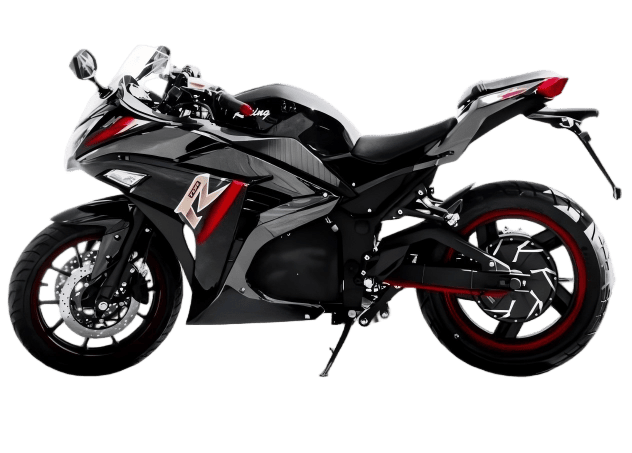
R3 et montage central
| Moteur : | 5000W Tile Motor (Mid-Mounted) |
| Vitesse maximale : | ≤ 120 km/h |
| Weight: | 120 kg (sans batterie) |
| Pneu : | 110/70-17 Front / 140/70-17 Rear |
| Brake: | Dual Disc Brake (Front + Rear) |
| Suspension: | Hydraulic Front / Single Rear |
| Reverse: | Oui |
| Dimensions: | 2040×710×1130 mm |
| Colors: | Noir / Blanc / Bleu / Rouge |
Caractéristiques techniques complètes du produit
Performance & Motor
| Paramètre | Valeur |
|---|---|
| Motor Configuration | 17-inch 5000W Tile Motor (Mid-Mounted) |
| Vitesse maximale | ≤ 120 km/h |
| Net Weight (without battery) | 120 kg |
| Capacité d'escalade | Pente ≤ 20° |
| Changements de vitesse | Boîte de vitesses à 3 rapports |
| Fonction « Inverser » | Oui |
Chassis & Geometry
| Composant | Caractéristiques techniques |
|---|---|
| Dimensions de la carrosserie (L × l × H) | 2040 × 710 × 1130 mm |
| Empattement | 1 440 mm |
| Garde au sol | 170 mm |
| Suspension avant | Amortisseur hydraulique |
| Suspension arrière | Amortisseur hydraulique simple |
| Dimensions de l'emballage | 1940 × 550 × 1050 mm |
Freinage et caractéristiques
| Système | Caractéristiques techniques |
|---|---|
| Pneu avant | 110/70-17 (Sport Profile) |
| Pneu arrière | 140/70-17 (Sport Profile) |
| Frein avant | Frein à disque à commande manuelle |
| Frein arrière | Frein à disque à commande manuelle |
| Feux de détresse | Oui |
| Affichage des instruments | Vitesse / Batterie / Clignotants / Phares |
| Couleurs disponibles | Noir / Blanc / Bleu / Rouge |
Développez l'identité de votre marque
Tailor the R3 to create a distinctive performance brand that appeals to riding enthusiasts and motorsport culture. All customization options are designed to enhance the sport-oriented character that defines this model.
✓Racing Livery & Brand Identity — Sport graphics, stripes, and decals with team-color paint and logo integration.
✓Performance & Electronics — Upgraded controllers, sport suspension, and brakes with sport mode, traction control, and data logging.
✓Sport Comfort & Premium Components — Bolstered seat, adjustable ergonomics, forged wheels, carbon panels, and premium brakes.
Minimum Order — 20 units standard / 30 units full customization
Délai de livraison — 45-50 days for performance specifications
FOIRE AUX QUESTIONS
Q1: What advantages does mid-mounted motor configuration provide?
The mid-mounted motor sits centrally between the wheels, giving near-ideal weight distribution and a low center of gravity that improves handling, high-speed stability, and steering feedback versus hub motors. It also enables direct chain or belt drive with a multi-speed transmission that hub motors can’t practically use. The result rides like a traditional motorcycle rather than a front-heavy scooter.
How does the R3 compare to hub motor electric motorcycles?
The R3 feels nimble and responsive like a traditional motorcycle, while hub-motor bikes tend to feel nose-heavy with sluggish steering. It uses a conventional chain needing periodic lubrication versus sealed, maintenance-free hubs, but costs 20-30% more for the performance serious riders value. Hub motors remain the practical pick for utility-focused, low-maintenance use.
What is the realistic performance with 5000W power?
The 5000W mid-mount accelerates 0-60km/h in about 2.5-3.5 seconds and reaches a genuine 120km/h, climbing 20° grades at 40-50km/h. The 3-speed transmission optimizes power—first gear for launches, third for 80-100km/h cruising—but draws 40-60% more battery than 2000-3000W motors and needs more frequent maintenance.
What regulatory classification applies to 5000W electric motorcycles?
At 5000W and 120km/h the R3 is classified as a motorcycle worldwide, requiring registration, licensing, insurance, and compliance such as EU L3e, US state motorcycle rules, and Asian full licenses. The upside is full performance and legal highway use; we can apply software speed limiting for markets with thresholds, though that underuses the bike. B2B buyers are motorcycle-comfortable customers rather than e-bike convenience seekers.
What is the expected range and how does riding style impact it?
Range scales with riding style: roughly 100-120km conservative urban (72V 60Ah, 40-50km/h), 60-80km spirited, 40-50km at 100-120km/h, and 30-40km on track. The 3-speed box improves efficiency 15-20%, cold weather below 10°C cuts 25-30%, and extended or dual batteries add 40-50% capacity. It’s built for performance, not maximum range.
What maintenance is required for mid-mounted motor systems?
Mid-mount upkeep adds chain care (lube every 300-500km, replace 3,000-5,000km), sprocket swaps (6,000-10,000km), bearing checks (10,000km), plus intensive brake and suspension service. Total costs run about 40-50% above hub motors—accepted as the price of performance—and we supply maintenance schedules and technician training.
Can the R3 be used for track days or racing events?
Yes—the R3 suits amateur track days and club racing thanks to its mid-mount and sport geometry, though 5000W trails pro machines rated 15,000-25,000W. We recommend upgraded brakes, track suspension, tire warmers, and dual batteries; unlike trailer-only race bikes, it’s street-legal to ride to and from the track.
What tire selection is available and how does it affect performance?
The 17-inch wheels take standard sizes (110/70-17 front, 140/70-17 rear) from major brands. Sport-touring tires (Michelin, Bridgestone) suit street use at 6,000-10,000km; sticky sport tires (Pirelli, Dunlop) grip hardest but wear 3,000-6,000km and struggle in rain; budget touring lasts 8,000-12,000km cheaper but feels vague. Standard fitment means competitive pricing and local sourcing.
How should dealers position the R3 versus other electric motorcycles?
Position the R3 on its mid-mount handling and riding experience, not specs—lead with test rides on varied roads against nose-heavy hub bikes. Target motorcycle-experienced riders, price at a premium rather than racing utility scooters on cost, and build community via rides and track events with motorcycle-channel partners. It wins as the serious rider’s choice, not the accessible option.
What training and support do dealers need for mid-mounted motor systems?
Dealers need motorcycle-level capability: 3-4 days sales training (mid-mount pros/cons, classification, test-ride safety, financing) and 5-7 days technician training (HV safety, drivetrain, suspension, brakes, diagnostics). Track support adds 2-3 days, and the workshop needs lifts, chain tools, suspension gear, and HV safety equipment. We supply manuals, software, a hotline, and on-site training for 50+ unit orders.