







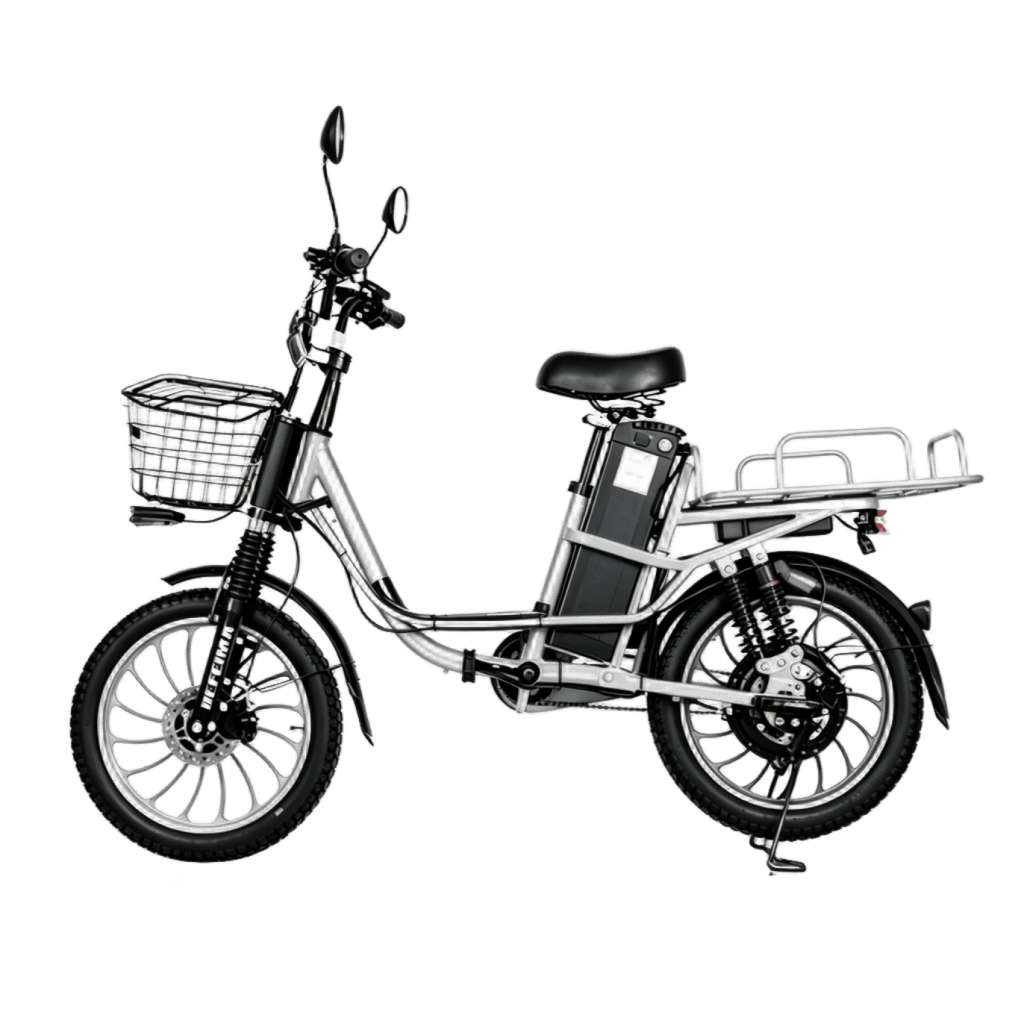
Elektrofahrrad – Princess
Vollständige Produktspezifikationen
Leistung & Kraft
| Parameter | Wert |
|---|---|
| Motorleistung | 500W / 1000W High-Torque Motor |
| Maximale Tragfähigkeit | 200+ kg (Reinforced Frame) |
| Batterietyp | Blei-Säure-Batterie / Lithium-Batterie |
| Motorschloss | Arretierung des Hinterradmotors |
| Recommended Use | Cargo Delivery, Heavy-Duty Commercial |
Aufbau und Komponenten
| Komponente | Spezifikation |
|---|---|
| Rahmenkonstruktion | Reinforced Heavy-Duty Frame |
| Gehäusematerial | Schlagfester Kunststoff |
| Reifentyp | Hochleistungs-Vakuumreifen |
| Bremssystem | Front + Rear Drum Brakes (Heavy-Duty) |
| Rückspiegel | Ja (links und rechts) |
Beleuchtung und Sicherheit
| Funktion | Spezifikation |
|---|---|
| Scheinwerfer | LED Headlights (High-Brightness) |
| Blinker | Doppelte Blinker vorne und hinten |
| Instrumentenanzeige | Digital Display (Speed, Battery, Load) |
| Fernbedienung | Ja (schlüssellose Zentralverriegelung) |
| Zertifizierung | CE- und DOT-Zulassung vorhanden |
Gestalten Sie Ihre Markenidentität
Customize the Princess to match your target audience and brand positioning. Bulk orders (100+ units) can choose from the configurations below to build a differentiated product lineup.
✓Batterie & Motor — Blei-Säure-Akku (Preis) oder Lithium-Akku (geringes Gewicht, größere Reichweite); 350 W im Stadtverkehr / 500 W in hügeligem Gelände.
✓Farbe & Markenidentität — Pastellfarbene oder individuell wählbare Gehäusefarben; Logo auf den Seitenwänden, dem Sitz und der Schutzscheibe; individueller Startbildschirm.
✓Sitz & Komfort — Standard-Komfortsitz oder hochwertigerer Sattel mit Rückenlehne.
✓Ausstattungspakete — Frontkorb, Gepäckträger, Handyhalterung, USB-Anschluss.
Mindestbestellmenge — 50 Stück Standardausführung / 100 Stück vollständig nach Maß gefertigt
Lieferzeit — ca. 35–40 Tage
HÄUFIG GESTELLTE FRAGEN
What makes the 200kg+ load capacity possible?
Through reinforced engineering: thicker-wall tubing with extra welds at high-stress points (seat post, rack, axle), heavy-duty rear springs, reinforced rims with more spokes, a strengthened motor bracket, and heavy-duty vacuum tires with reinforced sidewalls. This safely carries rider plus cargo over 200kg versus the typical 120-150kg on standard e-bikes.
When should I choose 1000W motor over 500W?
Choose 1000W for hills over 15°, loads of 150-200kg, riders over 100kg, or long industrial routes with frequent stops. Note 1000W may exceed street-legal limits in some regions, uses 30-40% more battery (cutting range similarly), and runs hotter. For urban loads under 120kg, 500W is enough and cheaper.
How does this model differ from Princess Lanqi?
Different segments: Lanqi is style-focused for female commuters (150kg, 350/500W, retro look); Princess is industrial cargo (200kg+, 500/1000W, reinforced frame, no styling focus). Princess costs 15-25% more but offers 30-40% higher payload, justified for commercial use.
What are the recommended applications for this high-capacity model?
Ideal for cargo delivery (40-60kg goods plus rider), industrial campus transport, family use in developing markets (2-3 passengers, 200kg+), agriculture and rural transport, heavy-rider markets, and municipal or government fleets.
What is the expected range with heavy loads?
With 500W + lead-acid at 200kg: 25-35km flat, 15-25km hilly; lithium extends to 40-55km flat / 30-40km hilly. 1000W cuts range about 30%: lead-acid 18-25km flat, lithium 30-40km flat. Figures assume 20-25km/h mixed traffic; plan at 70% to cover aging and weather. Fleets often pick lithium to avoid mid-shift charging.
Are the standard drum brakes adequate for 200kg loads?
Yes—heavy-duty drum brakes, not passenger-grade: oversized shoes and more contact area stop 200kg+ reliably. The enclosed design resists water and mud, needs less maintenance than discs in harsh conditions, and tolerates heat on long descents. Trade-off: less initial bite, so anticipate stops earlier. A disc option is available for 200+ units (+8-12% cost).
What maintenance intervals are recommended for heavy commercial use?
Under daily max-load use: inspect tires weekly, replace every 8-12 months or 8,000-12,000km; adjust brakes monthly, replace shoes every 6-9 months; lead-acid needs monthly water checks and 12-18 month replacement, lithium lasts 2-3 years; clean and lube chain weekly, replace 12-18 months; inspect suspension every 3 months; check motor and electrical quarterly. Rotate bikes out every 2-3 months for systematic inspection; training provided for 100+ unit fleets.
How many units fit in a container and what is the packaging?
Each unit ships 85% pre-assembled in a reinforced carton (~155×50×75cm). A 20GP holds about 120-140 units, a 40HQ about 280-320. This is 15-20% fewer than lightweight models due to reinforcement, but the higher per-unit value keeps the shipment attractive. Assembly takes 20-25 minutes; wooden crates are available for ocean shipping.
What warranty applies given the heavy-duty commercial use?
Frame 2 years (vs standard 1); motor 1 year or 15,000km; electrical 1 year; battery 1 year/300 cycles (lead-acid) or 2 years/800 cycles (lithium). Wear parts (tires, brake shoes, chain) are not covered. Fleets of 200+ get extended warranty, priority parts, and expedited replacement.
Why choose the Princess over a dedicated cargo trike?
The Princess reaches narrow streets trikes can’t, costs 40-60% less, is simpler to maintain, and more riders already know how to ride it. Its 200kg covers most needs, though trikes reach 300-400kg. Trikes win only for very heavy single loads or stability needs; many fleets run Princess for 70-80% of deliveries and trikes for the rest.